As one of hundreds of thousands of unwed mothers wrenched from their newborns, I never recovered from the loss – even after we were reunited
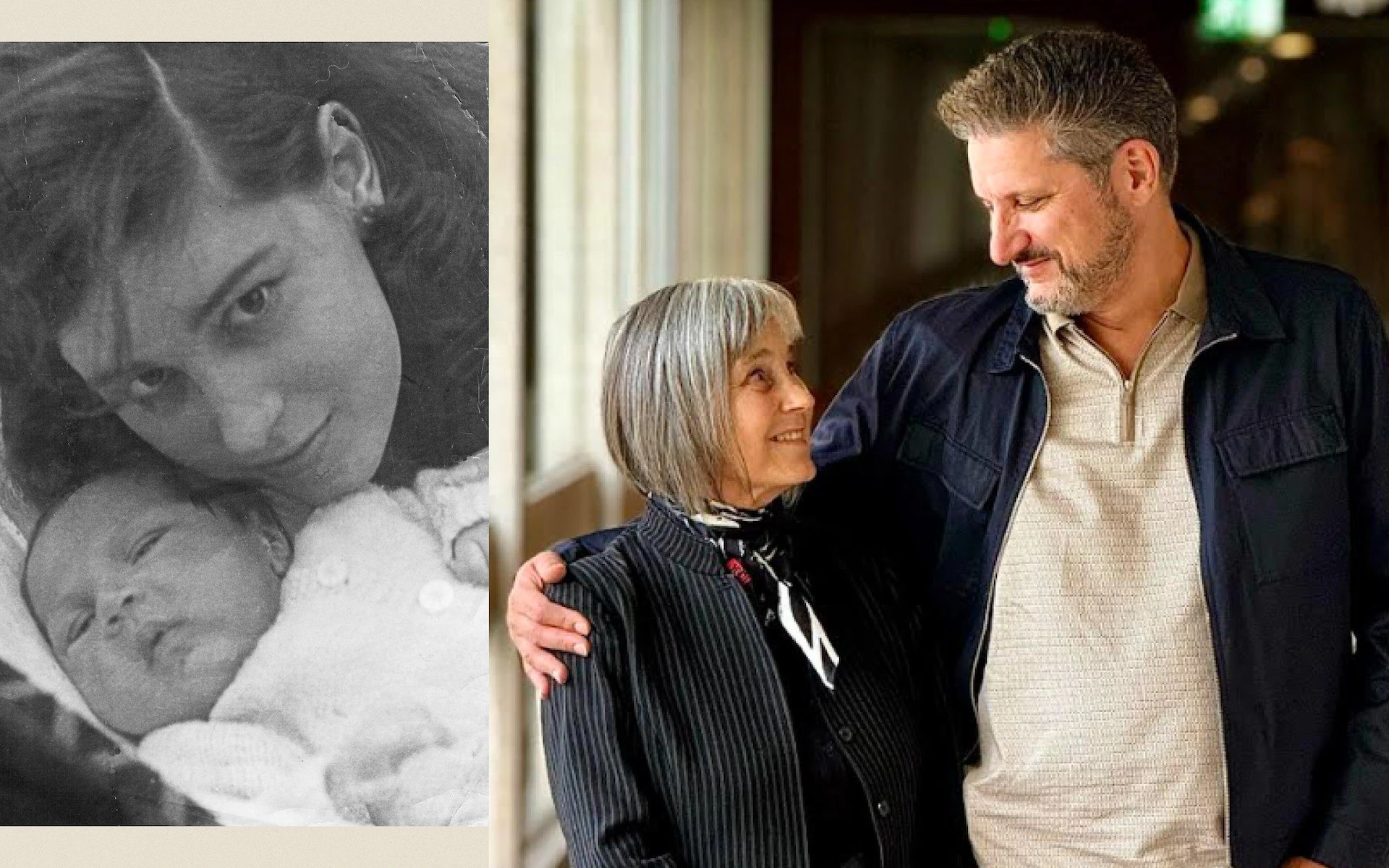
Mary Husted in 1963 with Luke, later renamed Ian, and mother and son today
I gave birth on a frozen winter day in 1963, aged 18. All these years later, I can still hear the words: “Mary, you have a son.” He was a big baby, and the moment I saw him, I felt a searing, overwhelming love. There was terror mixed in with the love, however – as I knew I would soon be parted from this boy who was already so precious to me. I decided to name him Luke – it was a rather unusual name in those days, and I hoped that it would make him easier to track down later.
Luke was fostered at two weeks, and later adopted, but for that first fortnight, we stayed in a mother-and-baby home near Reading and I was allowed to keep him with me. I spent every waking moment staring at him, drinking him in: the shape of his head, the way he arched his back when he stretched; I listened for his breath, looked at his tiny chest as it rose and fell. I drew him, too: small pencil sketches. I knew that very soon, they would be all I had of him. At night, he was taken away. I was bereft. I didn’t want to cause a nuisance so I learnt to cry completely silently – something I did on many occasions afterwards, thinking of the boy I’d lost.
‘I decided to name him Luke,’ Mary says of her son. ‘It was a rather unusual name in those days, and I hoped that it would make him easier to track down later’ – John Lawrence
Handing him over to be fostered was an indescribable wrench. The night before, I was so distraught, the matron gave me a drink and sat with me as I cried my eyes out. When the time came to give him to his new foster mother, I asked to hold him one last time. I looked down at his tiny face, peeping through the shawl I’d wrapped him in. Everything in me wanted to keep him, but I’d promised my family I would give him up. So I did. It was 44 long years before I saw him again.
I was 17 and studying at an art college in Worthing when I realised I was pregnant. It came as a surprise – I had a boyfriend, a Persian engineering student, but we’d been using a pessary as protection, which he’d assured me was safe. My mother had died giving birth to me and my twin sister in 1944, so we’d been raised by my maiden aunt; sex wasn’t discussed in our family, as was the norm then. This was the 1960s, so of course there was a bit of experimentation going on, but the culture where we lived in Sussex was still very much of the 1950s. Girls like me weren’t chaperoned as we would have been 10 years before – but we also weren’t well informed.
My immediate feeling on learning I was pregnant was fear. It’s almost unimaginable now, but back then, pregnancy out of wedlock was deemed a wicked thing. It brought shame on an entire family. I was a nice middle class girl from a good family; my aunt, who I regarded as my mother, asked me: “How could you do this to us?” My father was devastated.
It was another aunt who decided I was going to put the baby up for adoption. Everyone immediately fell into line. I was told that I would be showing my child the ultimate love by giving it up; that another family could offer a life that I could not hope to provide. The pressure to keep my pregnancy a secret before I “began to show” was considerable, and soon, a story was concocted that I’d gone to Germany to continue my studies there. To make the story credible, I wrote letters to friends, which were mailed to Germany – then back to the UK. Meanwhile, I was whisked away to see out the pregnancy at a friend of my aunt’s, near Reading. The only other person who knew I was pregnant was my twin, Roma, but even she was not told where I was when I was sent away.
Mary while pregnant with Luke in the summer of 1962. ‘The pressure to keep my pregnancy a secret before I began to show was considerable,’ she says
Before the pregnancy, I’d worshipped the man who had got me pregnant – he was a few years older than me and seemed honourable and glamorous and grown-up. Looking back, I can see that he was just scared and spoilt, and that I wasn’t even the only girl he was seeing. He couldn’t bring himself to explain to my father how he had come to get me pregnant; he certainly didn’t seem inclined to marry me. There was no evidence that the child was his, he pointed out, implying I might have slept with someone else, which I wouldn’t have dreamed of doing.
At first, the idea of putting my baby up for adoption felt like a way out of my desperate situation. But as the pregnancy progressed, I began to feel my child move and turn and kick. I began to speak to the baby. An attachment grew, which became all-consuming once I’d given birth.
Signing the adoption papers at a courtroom in London was harrowing. For a long while I just sat there, unable to compel myself to do it. Then I thought of the woman who was hoping to raise my baby boy – by then, she had met Luke. They must have fallen in love with each other, I told myself. I signed the papers. I gave my beloved boy away.
I got a job with Lufthansa in London, met a nice man and married him. I was told by everyone who knew of my secret – doctors, midwives, family members – that I should just move on with my life. People were often trying to be nice, saying, in effect: “You’re lucky, you’ve been given a blank slate. Don’t look back.”
But the loss changed me profoundly. When my daughter came along a couple of years after Luke’s birth, I suffered from what I see now was postnatal depression. I was anxious that I would lose her too, and would burst into tears every day for months. I felt – I have felt this many times over the years – that I was having to pay for what I’d done in giving up my other baby. And I thought of Luke constantly, of course. When he was young, I wondered if he might be in the prams that passed me in the street. Later, I would see children bounding out of school and wonder – are any of those little boys him?
Though I had three children quite quickly, with my first husband, Bill, the marriage broke down – mostly because of me. My husband, who knew about Luke, couldn’t understand the sadness I felt, the way it would return and return. I had learnt by then that no child can replace a child that is lost.
I wanted to find Luke as soon as he turned 18, but in those days, the law made it difficult. I had married again – this time it was a better match – and had had another child. As the older children began leaving home, I threw myself into my work as an artist. In 1991, I made a painting entitled Dreams, Oracles, Icons, which shows a mother and baby, separated. It drew, of course, on my own experiences. The following year, it was chosen to be part of the Women’s Art Collection at New Hall College, Cambridge. A part of me hoped that my son would somehow see the painting and find me: that he’d realise I had been longing for him all these years.
By 2007, the law around adoption reunion had changed and I was working with various authorities to find Luke. Then, in September, I received an email from someone saying he was investigating his family tree. “Is your search connected to Luke Husted?” I replied. “Yes, that’s me,” he replied.
I cannot describe how I felt. A flurry of emails followed – it turned out that my Luke had been raised as “Ian”, but that he’d had a son himself, and named him Luke. My Ian/Luke had looked me up on Google and found the painting. As I’d hoped, it had drawn him to me.
We arranged to meet at Kew Gardens on a golden October day. I stood waiting for him. He was a bit late – parking issues, he later explained – and suddenly: there he was. My son. My whole body, every muscle, was tense, clenched absolutely tight. It was the most intense moment of my life. “You are…?” I said. “Yes, and you are…?” he replied. “Yes,” I said. “I have your chin,” he said. “And you have your father’s eyes,” I said.
Mary and Ian on the occasion of their first meeting in 44 years, in October 2007
We sat on a bench in the piercing sunlight. I gave him the sketches I had made of him in those early, precious days together. He gave me a Bible he’d had since he was a boy. Haltingly we began to ask about each other’s lives, to exchange pictures: his wife, his children; my husband, my children. He also showed me photos of himself as a boy. Those were difficult to see. I had the man beside me, but the child, I knew, I would never get back.
Meeting my son 44 years on from his birth was both wonderful and awful, a vast, incomprehensible experience. It was so strange: I loved him intensely but I didn’t know him. After some time, I made myself say what I had been wanting to say for many years: “I am so sorry I gave you away. Can you forgive me?” He looked directly into my eyes. “There is nothing to forgive,” he said.
Today, Ian has folded beautifully into my family. I live in Barry in Wales, and he’s in Stratford-upon-Avon, but we see each other as much as we can. In the early, giddy years of our reunion we would speak every day, but now we communicate just as often as I do with my other children: once a week or so. There is joy in that normalisation.
And he had, I am relieved to report, a happy childhood. It may have helped that he was told that his birth mother – me – had been reluctant to give him up. Even so, I struggle with the years I missed. He would have fitted in so well with my other children. I’m 81 now. I know the boy I lost will never return to me.
Ian (left) and Mary (right), with Darrell and Joan, who hosted and cared for Mary in Reading
I am aware, though, that I am one of the lucky ones. There are thought to have been around 250,000 women who were forced or coerced to put their children up for adoption in Britain between the 1940s and the 1980s. Some mothers never lived to see them again. In other cases, it was the children who suffered – they went looking for their mothers and were rejected, for what felt like the second time. It was only in March this year that Keir Starmer said he was considering issuing an official apology on behalf of the Government. It’s about time. No apology could undo the trauma that many victims have experienced, of course, but it would mean a lot nonetheless.
I’ve had a good life, but losing my son has come back to haunt me again and again; it has made me, I regret to say, a rather distant mother at times. In cases like mine, something is often missing on both sides. The mother is missing her child. And the child is missing knowledge of themselves.

 Trushali