ITV News has heard heartbreaking testimony from survivors about the racism they endured, Social Affairs Correspondent Sarah Corker and Senior Producer Lottie Kilraine report
Warning: this report contains offensive and outdated language referencing racist abuse suffered
Black and mixed heritage adoptees and care-leavers who faced “abhorrent” racism and prejudice during the forced adoption era want their lifelong trauma and suffering to be acknowledged by the church and state.
Mothers of mixed heritage children were told they had no choice and their babies would be “better off” adopted.
The reality was that the adoption and care system at that time deemed them as “un-adoptable” and “undesirable”, meaning many grew up in orphanages and children’s home, suffering abuse and neglect.
ITV News has heard heartbreaking testimony from survivors about the racism they endured, and how it has affected their whole lives.
‘I wasn’t adopted or fostered because I was not white’
From the moment Phil Frampton was born in 1953, his care records show that he was treated with prejudice and discrimination because of the colour of his skin, with racist language used throughout.
“The reason I wasn’t adopted or fostered was because I was not white,” he told ITV News.
“When I was a baby the matron wrote: ‘Philip is such a poor specimen of humanity and there are doubts about his intelligence’.”
His mother, Mavis Frampton, was one of hundreds of thousands of women who were forced to put up their babies for adoption because they gave birth out of wedlock, the ultimate social taboo in post-war Britain.
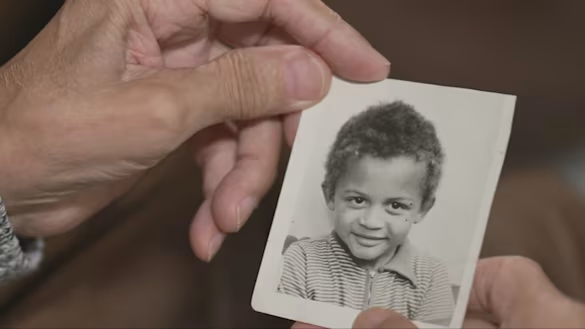
Dr Philip Frampton pictured as a child.Credit: ITV News
She had sought refuge at the Rosemundy Home for Unmarried Mothers in St Agnes in Cornwall, which was linked to the Church of England, hundreds of miles away from her home in Birmingham.
Instead of help, she was told to pray for forgiveness and labelled a fallen woman.
Dr Frampton told ITV News that his father, who was Black and from Nigeria, was removed from the UK for dating his mother.
He grew up in orphanages in the south west of England and then later children’s homes in the north west. At one point he was even sent to a home for disabled children, despite having no disabilities.
Rosemundy Mother and Baby Home in St Agnes, Cornwall, pictured in the 1950s.Credit: ITV News / Supplied
He was unaware of his own mother’s existence until the moment that, at 14-years-old, he was told that she had died.
Parts of his childhood in care were “brutal” and have shaped who he is today.
“All I had was Black skin, black curly hair, and I was abused and called all-sorts,” he said.
“How do you escape from that? You have to live in it. I grew up conscious of not being a citizen of this country.
“This is not 200 years ago, this is in our living memory. This is my life. It’s easy to say move on, but this isn’t the past, it’s part of me.”
‘The assumption was that Black children could not be adopted’
In 1962, June Thoburn was a childcare officer in Oxford City, and later in London.
She was not involved in the running of mother and baby institutions, but part of her job was to collect babies and place them into care or take them for adoption.
She recalls that the young, single mothers had very few options, and that there was inherent prejudice within the adoption system.
“The assumption was that Black children could not be adopted,” she told ITV News.
“The white babies were placed for adoption, the mixed heritage child would almost certainly go into care, usually a residential nursery.”
June Thoburn was a childcare officer in Oxford City, and later in London, in the 1960s.Credit: ITV News
She recalls how when some nursery staff considered if a child could be placed for adoption, they “looked at the fingers nails” to see if they could “pass for white”.
“Some of the mixed heritage children were brought up as white,” she said.
“We never looked for Black foster parents or adopters. It was not until the late 1970’s that we even had Black social workers, most were white and middle class, like me.
“I was unhappy with the suffering I saw. I’m sad to say I was part of that society. I was an employee,” she added.
It wasn’t until the The Children’s Act in 1989 required local authorities to “have regard to the different racial groups to which children within their area who are in need belong” and to ensure that the cultural needs of children from different ethnic groups are met when they are in care.
Our long running ITV news investigation has gathered shocking testimony from across Britain revealing layer upon layer of cruelty.
Single mothers were often told that they would be “selfish” to keep their babies and that the infants would have better lives once they were adopted by two parent families. The reality was often far different.
‘You carry that stigma for the rest of your life’
Margaret Moore spent the first three years of her life in an orphanage and then foster care. She believes she was never even considered for adoption because of her heritage.
Margaret Moore recounted her own ‘bleak’ start to life.Credit: ITV News
Ms Moore was born at St Pelagia’s maternity home in London the 1950s, which was run by Catholic nuns from the Sisters of the Sacred Heart of Jesus and Mary. She recounted her own “bleak” start to life.
She told ITV News: “On my medical records one of the things that really hurt me was that they said ‘it can hear’.
“I was considered coloured, that was the phrase then, biracial now. So my race was commented on and I think in the homes there was a tier system and I wasn’t considered ‘correct for adoption’.
“I say I carry a hole in my soul with it. You’re marked. You carry that stigma, you carry it for the rest of your life and the repercussions of it,” she added.
While those who were adopted were often placed with white families in white areas of England, feeling disconnected from their own heritage.
‘I was thought of as a problem’
Carmen Curran was also born in a home for unmarried mothers in Cumbria in 1961 and placed in an orphanage at 12 days old.
She told ITV News that she has seen “correspondence between the priests that confirms they knew my mother thought I would be adopted almost immediately”, but her adoption files state “you probably know that the child is very dark and the chances of adoption are almost negligible”.
Carmen Curran pictured as a child.Credit: ITV News
“It shows I was thought of as a problem, and they knew that I would very likely spend a long long time in an institution,” she added.
She was two-years-old when she was adopted. Although she had loving adoptive parents, questions over her identity always loomed large as she grew up in a white working class community in the north east of England.
ITV News analysis of government archives, newspaper clippings and academic journals from the 1960s shows racism was widespread throughout the adoption system in thew 1950s, 60s and 70s.
In the Journal of Race and Group Relations academics discuss “the improbability of adoption for non-white children” in 1968, concluding “it presents a fairly serious problem in a few areas”.
While newspaper articles from Home Office archives from the 1960s and 70s detail how children were not placed for adoptions “because their skins look different”, describing the babies as the “new faces in the children’s homes of Britain – the faces which don’t fit outside”.
An article in the Times newspaper in 1968 states that “some reasons for the reluctance to adopt are familiar enough … fear of what the neighbours will think looms large”.
In another journal academics commented on “adjustment” issues for those who were placed with families.
“A little girl comparing the colour of her skin with that of her adoptive parents was found trying to scrub her hands and arms white with soap powder,” it noted.
There is now growing pressure for the church and the state, who played central roles in these cruel practices to officially apologise and support those who continue to suffer, including those who “experienced racism at every turn”.
Responding to this report, a government spokesperson said: “This abhorrent practice should never have taken place, and our deepest sympathies are with all those affected.
“Racism of any kind has no place in our society and it is deeply disturbing that it played a part in these appalling cases.
“We take the issue of historic forced adoptions extremely seriously and continue to engage with those affected to provide support.”
Campaigners are calling for a formal government apology for Britain’s forced adoption scandal.Credit: ITV News
The Church of England operated and funded 107 mother and baby homes, including Rosemundy in Cornwall, where Dr Phil Frampton was born, and had over 30 adoption agencies.
A Church of England spokesperson said: “Any instance of racism is abhorrent and has no place in the life of the Church and we condemn it unequivocally. These accounts are deeply distressing and sobering.
“We know that many people experienced deep harm in connection with historical adoption practices, including within some mother and baby homes linked to the Church of England.
“This is a cause for great regret and sorrow. The Church of England is engaged in work to understand its history, including the pain and trauma this has caused, and to address the impact it continues to have on people’s lives.
“These events took place in a period when harmful and prejudicial societal attitudes often went unchallenged, and the Church of England was part of that context and contributed to those attitudes. We recognise the harm this caused.”
In 2016 the head of the Catholic Church in England and Wales apologised “for the hurt caused by agencies acting in the name of the Catholic Church”.
Cardinal Vincent Nichols acknowledged “the grief and pain caused by the giving up of a child through adoption”, and added that “the practices of all adoption agencies reflected the social values at the time”.
If you have been affected by the issues in this report, please visit these links for help and support:
PAC UK– Specialist therapy, advice, support, counselling and training for all affected by adoption and permanency
Safe Spaces – an independent service offering confidential support to survivors of Church-related abuse on 0300 303 1056 or on their website
Samaritans is an organisation offering confidential support for people experiencing feelings of distress or despair. Phone 116 123 (a free 24-hour helpline)
 Trushali