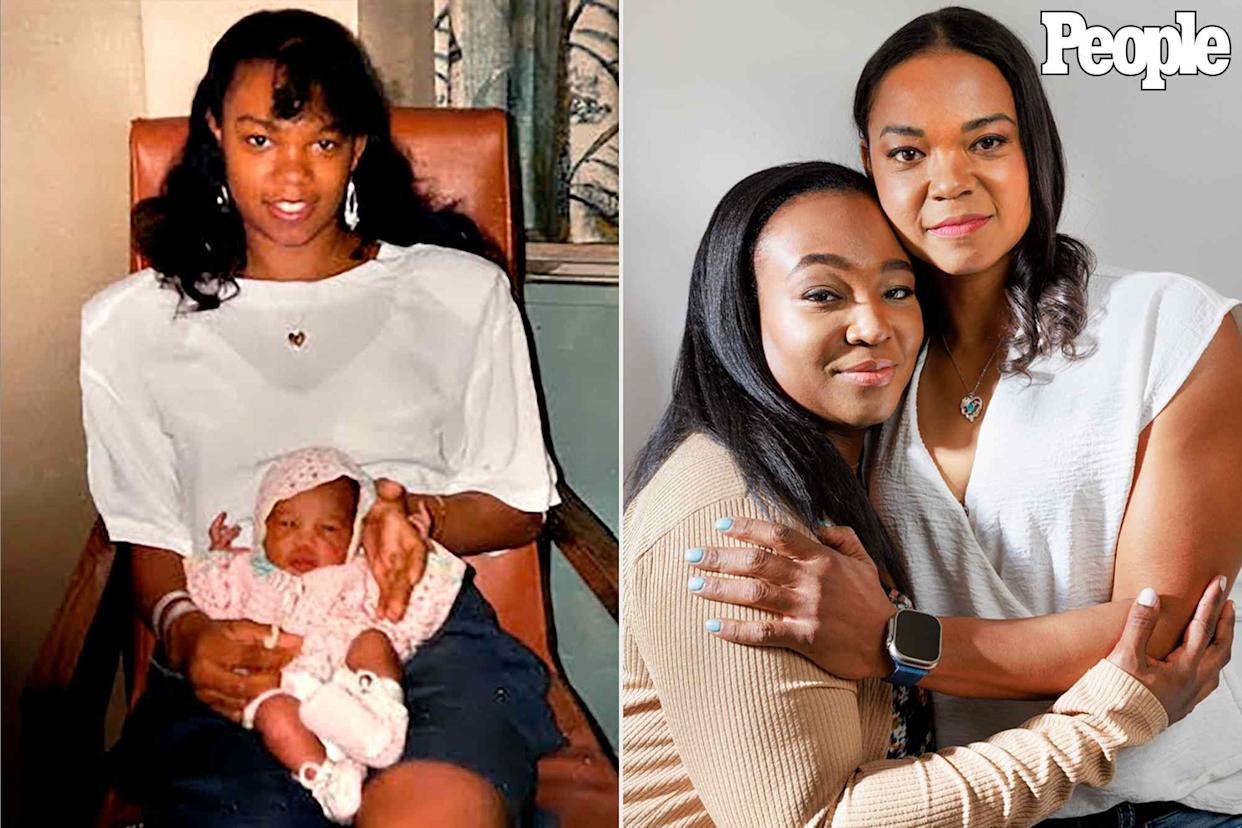
From left: Zoe Shaw with baby daughter Sara Valentine in 1991, before she was placed for adoption; and right, together in January Credit: Courtesy Dr. Zoe Shaw; Elinor Carucci
NEED TO KNOW
For 40 years the Liberty Godparent Home, one of nearly 500 such maternity facilities across the nation (many of which have religious affiliations), offered itself as a safe haven for girls in crisis
Now the young women who stayed there are speaking out about the good and the bad
Zoe Shaw lived there for several months in the 1990s and says she was pressured into surrendering her newborn daughter — a loss that haunted her for nearly two decades
One afternoon last February, as rain poured down on a villa in the Greek port town of Rafina, Dr. Zoe Shaw felt the urge to pinch herself.
The smell of cooking in the kitchen filled the home she rented to celebrate her 50th birthday, and all around her were family members, including her 34-year-old daughter Sara Valentine, who Shaw had been forced to place for adoption as a teenager.
She vividly remembers her grandchildren playing and picking lemons from trees. “Everyone was singing ‘Happy Birthday’ to me,” Shaw recalls in this week’s issue of PEOPLE, on newsstands Friday. “It was really beautiful to be able to have some closure like that. It was very healing.”
Closure is something Shaw spent much of her life searching for after the trauma of handing over her newborn as a 16-year-old in 1991. In the years since, Shaw discovered she was one of hundreds of predominantly teenage girls who spent their pregnancies at the Liberty Godparent Home, a facility that operated first near and then on Liberty University’s campus in Lynchburg, Va.
For 40 years the maternity home, one of nearly 500 across the nation (many of which have religious affiliations), offered itself as a safe haven for girls in crisis.
Some of the young women who lived there say the support was critical — ballast in a storm. But others say they were isolated and allegedly pressured into surrendering their babies to families who better fit the facility’s spiritual views and emphasis on having children inside a Christian marriage.
“I had so much shame,” says Shaw, a mom of five who reunited with Valentine in 2010, nearly two decades after they were separated. “I still grieve over the fact that I lost her childhood.”
Now Shaw and others who spent time at the maternity home — created in 1982 by Dr. Jerry Falwell, the political activist and Baptist televangelist who founded Liberty University, one of the nation’s most famous Christian schools, though the Godparent Home is a separate entity — are speaking out about the good and the bad.
Expectant moms like Abbi Johnson and Elizabeth Willett tell PEOPLE that staffers urged them to hand over their babies while they were at the center; others, like Wendy Cabell, say going to the home gave them important resources and insight.
Willett was a few months pregnant when her parents dropped her off in 2002, and the former Teen Miss Virginia repeatedly told the Godparent Home, “I’m not giving my baby up,” she says.
One of 11 girls there then, she butted heads with counselors who, she says, constantly reminded her that “you are about to eff this kid’s life up.” Willett left on the day she turned 18 and kept her son.
“It wasn’t always easy,” she says. But she describes Isaac, 23, as “the most important person to me.”
Johnson was pregnant at 16 and desperate to raise her child herself, but, she says, her parents said no. She describes feeling “like a caged animal” at the Liberty maternity facility in 2008.
Worse, she says, she was led to believe she and boyfriend Nathan, who got married a year after their son’s birth, would have contact with their boy after his open adoption. But his adoptive parents cut off all contact when he was 14.
Inside the Liberty Godparent Home in 1991 Credit: Courtesy Dr. Zoe Shaw
Former director Janelle Basham, who stayed at the Godparent Home in 1993 before helping reform it in the 2010s, credits the facility with helping her place daughter Katherine with a loving family, but she admits: “Did the Godparent Home during that era do everything right? I don’t think so … and it breaks my heart.”
Basham was just 17 when she selected parents for her baby daughter in an initially closed adoption in February 1994. “I was not equipped to be a mom at that stage,” she says.
Her adoption counselor at the home told her, “You can make any decision you want,” and she’s been a part of her daughter’s life since Katherine was 8 years old and was there, later, to support Katherine during the birth of her own son when she was a teen.
“Katherine is my biggest accomplishment,” says Basham, adding that’s what she tells all of her children, including her son, 26-year-old Carson, and her daughter, 23-year-old Emma, whom she shares with her husband, Jason. (The pair met while attending Liberty University.)
Basham took over the Godparent Home, which is next to an adoption agency, as executive director from 2010 until 2016. “I came in with the mindset of, ‘This has to get licensed, this has to be treated in a different way,’ ” she says, and she successfully got the center licensed by the state.
“These women deserve better,” she continues. “Not to put me on a pedestal, but I understood what it’s like to carry shame.”
At 22, addicted to drugs and pregnant with her second child, Wendy Cabell was desperate when a friend suggested the maternity home at Liberty. “When I explained my story, they accepted me with open arms,” she says.
During her stay she not only kicked drugs but took classes on adoption and parenting before realizing she wasn’t ready to care for another child.
“Looking back on it now,” Cabell says, “it was the best decision I ever made.”
From left: Janelle Basham with daughter Katherine Credit: Courtesy Janelle Basham
As of 2022, the Godparent Home’s state-issued license had lapsed and the facility — which currently has no residents — is instead focused on providing support for older pregnant women in the community, according to a representative.
In a statement to PEOPLE, officials at the home defended their work, saying, in part, that they “treated every individual who has sought assistance with compassion and integrity.” But they’ve also come under scrutiny: In 2024 the U.S. Department of Education criticized Liberty for having forced “numerous” university students to stay at the home “as a condition of their continued enrollment.”
“All of the women I spoke with,” says T. J. Raphael, creator of the investigative podcast Liberty Lost, “described extremely traumatic experiences that have never left them.”
“What has impressed me most with each of the women that I’ve interviewed is their resilience and their sense of hope,” Raphael says.
The Liberty Godparent Home today
Found at Last
When Shaw learned she was pregnant in 1990, all the high school honors student could focus on was the “disappointment that I’d let my family and God down,” she says.
Her mother, Miranda, had previously donated to the Godparent Home. Upon learning her daughter was five months pregnant, Miranda made it clear that “this is where you’re going, and you’re going to come back without the baby,” according to Shaw.
The maternity home felt like a prison, says Shaw, who lived there for about four months. Locks were on the windows and doors. Communication with the outside world was closely monitored.
Two days a week, Shaw says, she and others were “paraded” before Falwell’s congregation. “It felt like we were on display to get people to donate,” she says.
The “most disturbing” moment was being asked to choose her baby’s adoptive parents from a book of photos and brief bios.
“I remember thinking that my mother wouldn’t even pick out a babysitter for me by looking at some pictures and a paragraph about them,” Shaw says, “and I’m supposed to choose the parents of my child based on this?” Also unsettling was how housemates seemingly disappeared after giving birth, Shaw says: “You never saw them again.”
Zoe Shaw at the Liberty Godparent Home Credit: Courtesy Dr. Zoe Shaw
When Shaw went into labor two weeks early, in May 1991, the pattern repeated: She was driven to a hospital and never returned. Giving birth — without pain medication — was “traumatic,” she says.
Hours later, she says she was told, “You don’t need to spend time with [your baby girl] and make it harder on you.” Shaw still gets emotional remembering the last kiss she gave the infant — whom she named Kaiya — and the feeling of numbness that swept over her when she left the hospital.
As she grew older she was never quite able to shake the emptiness in her heart that her daughter could have filled, despite getting married, having other children, earning a doctorate in clinical psychology and starting her own practice.
“I spent years fantasizing about her,” says Shaw, now 51, following the closed adoption, “and how I was going to go kidnap her and raise her.”
Then, in 2010, her phone rang. The little girl she’d always thought of as Kaiya had grown into 19-year-old Sara Valentine.
Sara Valentine as a newborn Credit: Courtesy Dr. Zoe Shaw
Using Facebook and a bit of gumshoe dedication, the college freshman had tracked down Shaw’s ex-boyfriend, her biological father, Vinnie, after she found an old letter he had written to her that had been passed on by the adoption agency, with the contact information redacted.
To glean clues about her birth family, Valentine held the note up to the light, peering through the obscuring markings.
Soon, Shaw’s former boyfriend took Valentine to lunch and he connected her with Shaw. “I literally dropped to the floor,” Shaw says of Valentine’s call. “All I could think was, ‘I missed my chance to go back and get her.’ ”
Later that year, mother and daughter reunited in person at the Las Vegas airport.
“We both locked eyes and we were just looking at each other smiling,” says Valentine of seeing Shaw for the first time as she came down the escalator at the airport. Tears and hugs ensued.
Zoe Shaw (second from right) with Sara Valentine and Valentine’s kids at home in Maryland in January Credit: Elinor Carucci
Valentine grew up in a happy family, with loving parents and twin brothers. But getting to know her birth parents “means everything.”
“I act like Zoe, and I act like Vinnie,” she says, “and it’s amazing to be able to see myself in them.”
Not everything is lost forever. Shaw says being reunited with her first child — now a substitute teacher in Maryland who has four kids, including a daughter, Kaiya, named in her honor — helped her find something new: freedom from shame.
Last year Shaw published a memoir, Stronger in the Difficult Places. “I’m so thankful,” says the grandmother of four, “that I get to know her as a woman and be part of her life.”

 Trushali