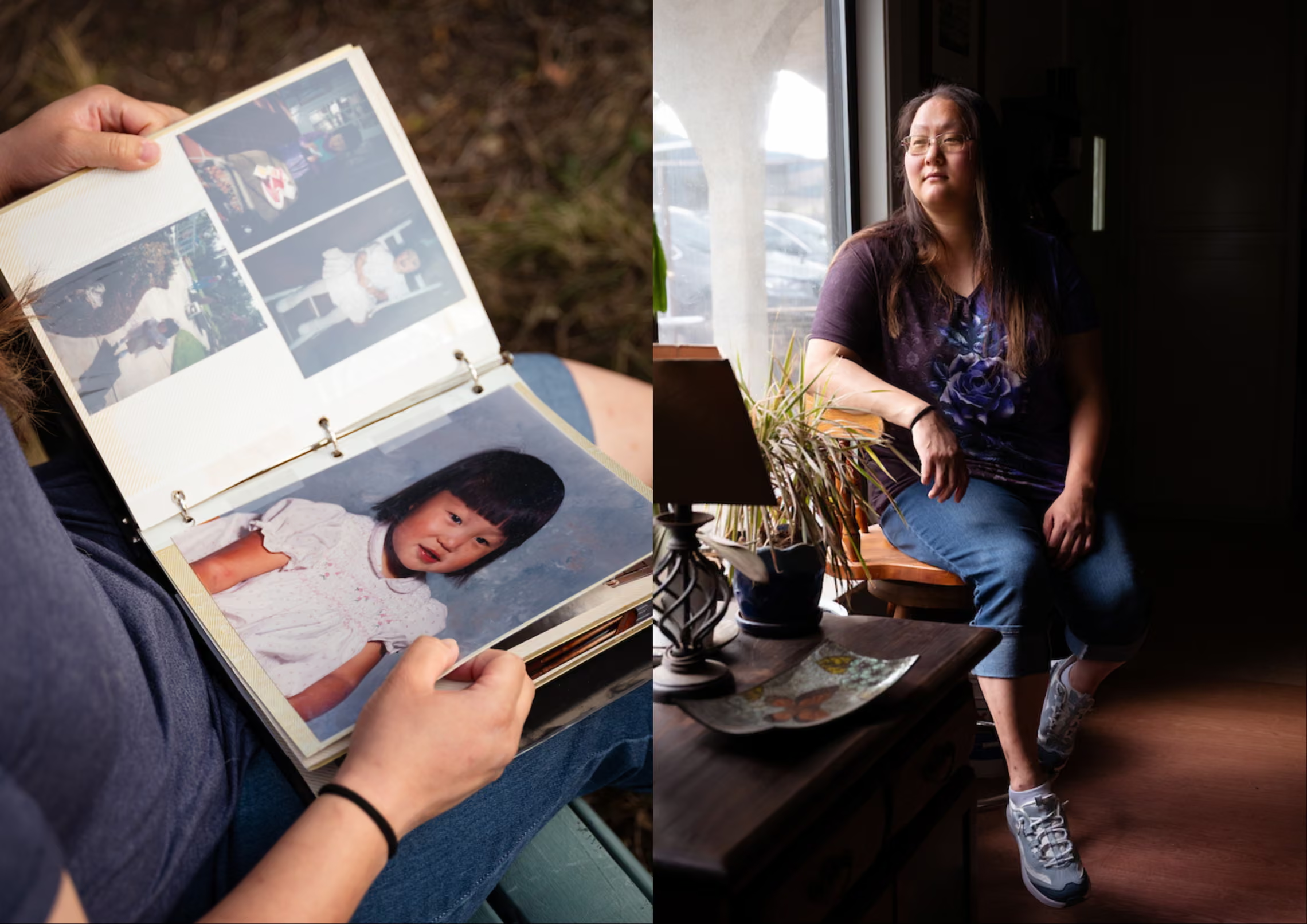
Lauren White-Gydas, a Korean-born adoptee at her home in Arlee, Montana, who was sterilised while living at a home for adopted children. At left, she views an old album of her childhood photos. Photograph: Rebecca Stumpf/The Guardian
Last year, South Korea took responsibility for enabling the ‘mass export’ of children for sale abroad. Now those uprooted are grappling with false promises of a better life
As international, transracial adoptees in their 30s in the US, Jacquelyn Wells and Lauren White-Gydas have things in common.
They were both born in South Korea to unwed mothers in the 1980s. Both were shipped to the US as newborns to join white families who eagerly welcomed adorable, new daughters. And neither knew many other Asians in the towns where they grew up – Wells in Westford, Massachusetts, and White-Gydas in Salem, Oregon.
But from there, their paths in the US split in dramatic, unpredictable ways.
On a sunny spring day last year, Wells, 39, sat in her cozy home in southern Maine, her babbling, infant son nestled in her lap and wedding photos of her recent marriage to her first-generation Asian American spouse lining the walls. In one, Wells poses in her white gown alongside her beloved adoptive mom, who wears a gold dress, and her Korean birth mother, in a flowing hanbok. They beam, smiles emblematic of more than just the happy occasion.
Wells was reunited with her biological parents, now married, and two full blood brothers during a trip to Seoul in 2018, when she was 31. She met her birth mother first, after reaching out through her adoption agency. “I was so afraid you were going to be so angry with me,” said her birth mother, who voluntarily relinquished Wells during a temporary breakup with Wells’s birth father.
Wells, a singer-songwriter, had a concert booked in the city the next day. Right before she went on stage she got a text: “I’m your brother. I’m on the high speed train, we are coming to your show.” From the stage she saw all four walk in, dressed in black, just like her. She later collaborated on a track with one of her brothers, singing in English as he rapped in Korean. “We became best friends,” she said.
Wells’s experience appears to be the epitome of “reunion porn”: feelgood stories of adoptees meeting birth families, which often go viral when shared online but ignore the complex nature of international, transracial adoption. It is for that reason that Wells, who is co-president of Boston Korean Adoptees, is reluctant to share hers.
Jacquelyn Wells (center) on her wedding day in 2022 with her adoptive and biological mothers (right) and her mother-in-law and sister-in-law. Photograph: Marina Zinovyeva Photography, courtesy Jacquelyn Wells
“I feel guilty that I won the adoption Lotto,” she said, “because I learned the stories of hundreds of fellow adoptees where the outcomes were nothing of the sort.”
Adoptees like White-Gydas.
White-Gydas also has a photo with adoptive parents on her wedding day, but to her it amounts to sugary frosting, hiding rot. There’s no longed-for baby in White-Gydas’s arms, because in 1999, when she was 10, her American adopters left her in a children’s home for failed adoptions. White-Gydas alleges the home’s director put pressure on her to have a surgery that cut out her womb and ovaries when she was 18, sterilising her.
After decades on separate paths, White-Gydas and Wells’s stories have converged again. In March of 2025, South Korea admitted government responsibility for enabling private adoption agencies to “mass export” Korean children for sale abroad, sometimes without the consent of birth families, since the 1950s. Now, more than 100,000 Korean-born adoptees in the US are asking themselves questions like: “Who am I, really? And how did I get here?”
Ye Nah Choi, later Jacquelyn Wells, being held by a carer before she left Korea in 1987. Photograph: Courtesy Jacquelyn Wells
An international reckoning
The story told in the US of international adoption is often presented as a holy trinity: a woman struggling in a poor country, a newborn in need of a better life, and a western couple with love and resources in abundance. It is familiar to anyone who watched celebrities such as Mia Farrow and Angelina Jolie popularise foreign adoptions. Katherine Heigl, whose older sister was adopted from South Korea, in turn adopted her daughter Naleigh from the same country in 2009. “It is this gorgeous girl … born of a young woman who could not raise her but could give her the gift of life … that made me a mother,” Heigl posted on Naleigh’s 11th birthday.
Last March, a Truth and Reconciliation Commission (TRC) convened by the South Korean government acknowledged the underhanded role South Korea played in delivering newborns to western couples’ doors.
It began in 1955, when an evangelical Oregon couple, Bertha and Harry Holt, were “led by God” to “save” thousands of mixed-race babies fathered by GIs during the Korean war and left on the streets in economically devastated, conservative South Korea. They adopted eight themselves and set up an adoption agency, Holt Children’s Services, to help other Americans do the same. Arissa Oh, a historian of Asian American immigration at Boston College, said a combination of Red Scare-era thinking, an inclination for white saviourism, and promotion by churches drove customers to the agency’s services. “People who had little interest in adopting brown babies in America went abroad to ‘rescue orphans’ from communism,” Oh said.
The original Korean war babies ran out by around the 1960s. But “orphan fever” had already spread across the US and Europe, where women’s increasing access to welfare, contraception and abortion would lead to shortages of infants to adopt domestically. “That’s when market mechanisms come in,” said Oh, who authored the book To Save the Children of Korea: The Cold War Origins of International Adoption. With the Korean government’s blessing, “competing agencies sprang up to keep the pipeline going”.
According to Oh, the surge in adoptions became a source of wealth, welfare savings and soft power for Korea, now the world’s 15th largest economy. Its blueprint was replicated by Russia, China, Guatemala and Ethiopia, among many, all claiming to struggle with rehoming children domestically due to poverty, medical needs or policies like China’s one-child rule. US politicians – including President Dwight Eisenhower, who the Holts lobbied in the 1950s; Senator John McCain, who adopted from a Bangladesh orphanage in 1993; and Hillary Clinton, who in 2012 called international adoption “an important matter of foreign policy” – have also championed the framework. International adoption to the US peaked in 2004, when 23,000 children landed on American soil. Adopters today pay an estimated $30,000 to $60,000 per foreign child.
Then in December, on the heels of the TRC, South Korea announced international adoption of its children will end by 2029. That means in three years’ time, many of the world’s most prolific “sending countries” will be closed for business: Romania, Guatemala, Nepal, Ethiopia and China have already banned or limited foreign adoptions amid accusations of trafficking children via international adoption.
Months before the announcement, Korea’s president, Lee Jae Myung, offered a “heartfelt apology” to adoptees and birth parents for the government’s complicity in allowing agencies to dismantle generations of Korean families so white people could make new ones in the west.
According to the TRC, which took three years to consider evidence from 367 adoptions to 11 countries between 1964 and 1999, young, mostly unmarried Korean mothers felt pressure to give up babies due to stigma and poverty. It confirmed fraudulent practices in 56 cases in which children were adopted without valid parental consent or with falsified records claiming they were orphans even if they had living relatives; the cases were handled by multiple adoption agencies, including the one set up by the Holts. Reporting in 2024 by AP/PBS Frontline went further, alleging children were kidnapped off the street and from hospitals to be adopted.
Harry Holt, upper left, checks the identification of one of the Korean orphans he brought from South Korea as they arrive in San Francisco, on 17 December 1956. Photograph: Ernest K Bennett/AP
Susan Soonkeum Cox, vice-president of policy and external affairs at Holt International, which split from Holt Children’s Services (South Korea) in the 1970s, acknowledged that some children were improperly separated from their families by Holt and sent on fraudulent documents, but told the Guardian there was “not evil intent” and denied that children were “trafficked”.
She said: “Holt is very concerned about [the Guardian’s reporting] and takes it very seriously. Holt feels strongly that every adoptee has the right to their own story and experience and how they interpret it belongs to them. Anyone who has come forward with experiences that were negative we respect that and we frankly are deeply saddened by it.”
Cox, a Korean-born adoptee to the US in 1956, continued: “Holt has been very determined to provide ethical, professional services. Were mistakes made in the beginning? Of course they were, but we were a very strong proponent of The Hague Convention [on Intercountry Adoption, established in 1993] because there had to be global standards.” Holt Children’s Services (South Korea) did not respond to a request for comment.
The revelations caused a wave of mass awareness among Korean-born adoptees in the US.
Katie Bozek, 45, a Korean-born adoptee and couples therapist in Grand Rapids, Michigan, said “waking up” to the dark reality of Korea’s adoption industry felt like being deprogrammed, or entering a multiverse like in the movie Everything Everywhere All at Once and becoming aware of infinite parallel lives she might have led.
“Thousands of adoptees are popping their heads out of the water, seeing [allegations such as] ‘kidnapping’, ‘trafficked’, and going, ‘where am I?’” Bozek said. “I don’t know how to explain to people that phrases like ‘I just found out my friend was kidnapped,’ ‘I may have been stolen’ or ‘my file is a lie’ are not extreme hypotheticals.”
Bozek’s adoption file claimed she was found near a police station in Korea in 1981. In 1982, she was adopted by a white Michigan family whom she loved. But outside the home, she endured painful, racist bullying, and yearned to be blond.
International adoptees are frequently the only person of color in mostly white families. On the advice of agencies to “not see race”, some families were unprepared to help adopted children deal with intrusive questions like: “where did they get you?” or “why didn’t your real parents want you?” In decades past, white adopters were more likely to downplay racist comments or ignore adoptees’ racial or ethnic backgrounds, leading to incidental promotion of whiteness as “normal” or “better”. Some Asian adoptees reported feeling isolated among Asian people too, who can perceive them as “too white to be Asian and too Asian to be white” – a double rejection.
Katie Bozek looking at the missing posters that adoptees put up at the memorial Omma Poom park in Paju, Korea. Photograph: Courtesy Katie Bozek
Growing up, Bozek had few Korean role models to teach her about her birth culture. “It was hard because the dominant adoption narrative says: ‘You went to the best country in the world! You should be grateful we saved you,’” she said. “But I [feel an] ambiguous loss of something … When I’m in Korea I can sense it, I can smell it, I can taste it.”
Bozek started searching for her biological parents aged just 13. While she hasn’t yet found them, in 2019 and 2021 she discovered two first cousins through 23andMe’s DNA testing. They are also US adoptees, and half siblings. It sparked more uncomfortable questions: were agencies plucking multiple children off the streets at the same time?
In 2018 Bozek became the executive director of Korean American Adoptee Adoptive Family Network (KAAN) – the first leader who is an adoptee, not an adopter. Since the initial TRC bombshell, KAAN has welcomed new members seeking support as they process complex feelings of anger, guilt and loss.
Thousands of adoptees, some of whom are in their 60s and 70s, await their turn to be heard by the TRC. In the meantime, many are trying to track down adoption paperwork in Korea. Despite widespread fraud, these files still contain scraps of evidence, making them holy grails to adoptees hoping to piece together clues about their origins, reclaim lost identity, and find family.
US adoptee Oh Myo Kim, 46, a psychologist in Brookline, Massachusetts, who specializes in adoption, was in Seoul on a Fulbright scholarship when the TRC’s report was announced and felt its full force hit the adoptee community. “Just off the top of my head, I know four Korean adoptees who found out they were stolen,” she said.
The mother of two, adopted by a white family in New Jersey in 1981, became an accidental activist when she co-founded Emergency Action for Records Storage (EARS) with other adoptees, after plans were revealed for the Korean government to centralise adoptee files in inadequate storage, possibly delaying access for years and damaging or destroying fragile paperwork. In between school runs and work at Boston College, Kim uses vacation days to fly 7,000 miles to lobby a foreign government to better care for the documents – and identities – of thousands of strangers, in a language she still speaks “like a child”, she joked.
Oh Myo Kim: ‘I feel like adoptees chase fiction. They chase ghosts.’ Photograph: Tony Luong/The Guardian
But adoptees are also searching for something files can’t always provide: a sense of belonging. “I feel like adoptees chase fiction. They chase ghosts,” Kim said. “On my paperwork it says my parents were married and gave me up as I was their fourth daughter, but there are no parental signatures. Do I have sisters?”
While the TRC surprised many adoptees, activists had sounded alarms since the 1970s, when the first adult adoptees from Korea found birth families and learned the truth of their adoptions. But the advent of commercial DNA genetic testing in the 2010s was the gamechanger, facilitating more reunions – as well as lawsuits against the Korean government from two birth mothers. One, Han Tae-soon, claimed her four-year-old daughter, Kyung-Ha, went missing while playing outside in 1975. Mother and daughter were reunited in 2019 after Tae-soon signed up to Korean DNA database 325Kamra and matched with Kyung-Ha, now Laurie Bender, a middle-aged nurse in California.
Bender only took the test because her US-born daughter was interested in their mysterious Korean roots. To her shock, Bender discovered Han had been walking the streets for 44 years, looking for her, until all 10 toenails fell off. “It’s like you’ve been living a fake life,” Bender told AP.
Han Tae-soon is suing the Korean government for $445,000, for failing to prevent Bender’s adoption through a children’s home that said she was an orphan despite a missing persons report filed with local police by her mother. A government spokesperson told the BBC in 2025 that it “deeply sympathises with the emotional pain of individuals and families who could not find each other for a long time” and would act based on the trial’s outcome.
The aftermath of adoption
While adoption agencies sold the dream of a better life, that wasn’t what awaited everyone.
Lauren White-Gydas, 37, was born in Korea in 1989 and at five months was adopted through Holt Korea by a white couple from Salem, Oregon. Problems started early. White-Gydas felt she wasn’t the “girly Asian” her adoptive mother desired. “I was a very explosive, angry child,” she said. Her therapist believes she was suffering from relinquishment trauma, a term increasingly used to describe anxiety, dysregulation, anger and depression experienced by many adoptees after separation from biological mothers.
“There was a lot of physical and emotional abuse, constantly screaming at me. I screamed back. They were not prepared for how much trauma I had,” White-Gydas said. “By the time I was seven I was completely stripped of everything. I was not allowed to have friends or go out or leave my room apart from school.” She has some happy memories of playing with her adoptive father but felt she had to earn her adoptive mother’s love.
In 1999, just after her 10th birthday, the couple put White-Gydas on a plane to Hope House in Nampa, Idaho, eventually terminating parental rights. “Being possibly abandoned by my biological parents and then abandoned by my adoptive parents pretty much told me … there’s something wrong with me,” White-Gydas said.
I don’t know whether I truly was given up or I was stolen. Do I have a mom in Korea who loved me?

 Trushali