The retention of adult adoptee personal records could be extended to 100 years under new government proposals, following testimony from campaigners who have spoken out about their “traumatising” experiences trying to access basic information.
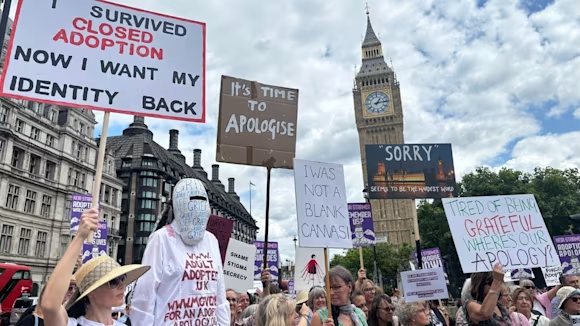
A consultation, launched by the government in July, following a public apology by the then-prime minister Sir Keir Starmer for the “shameful” practice of forced adoption in post-war Britain, closes on Friday.
Between 1940 and 1980, an estimated 250,000 women in England had their babies forcibly adopted because they were unmarried.
The months-long consultation has sought to obtain views on extending the minimum retention period for adoption records created between 1976 and 2005 from 75 years to 100 years, bringing them in line with more recent adoptions.
While some campaigners have welcomed the extension, others, including the Adult Adoptee Movement (AAM), argue the records should be retained for longer.
A spokesperson for the AAM told ITV News: “We are disappointed in the limited ambition of the government’s consultation on this issue.
“The Archives and Records Association (ARA), working alongside the Chief Archivists in Local Government Group, recommended a much longer preservation strategy than the government’s proposed 100-year statutory rule.
“The ARA suggested good practice should be 125 years, best practice 150 years, and the ultimate aim should be permanent preservation of all adoption and care-experienced records.
“Adoptees who have been separated from their families and identities have a reasonable expectation that the government do everything in its power to preserve their records,” they added.
As part of a long-running investigation by ITV News into historical forced adoptions, we have heard from adult adoptees across the country and the battle they have faced trying to find out basic information about the circumstances around their birth and adoption.
Adult adoptee Zara Phillips spoke to ITV News earlier this year about her struggle to access basic information about her early years and adoption:
Zara Phillips, 61, from North London, said she was “taken” from her mother as a baby in 1964, simply because she was unmarried. After two months in foster care, she was later adopted.
The legacy of that time continues to cast a long shadow on her life and she has been fighting to find out what happened to her during those early years.
She had waited for 18 months for an appointment with a social worker after requesting access to her adoption and care records from the council.
When she did eventually receive her documents earlier this year, she was told her file was still incomplete and some records were missing with little explanation why.
Reacting to the consultation closing, she said she is grateful that there are signs of change, but stressed the need for support and action to follow.
Zara Phillips pictured as a baby, was adopted in 1964.Credit: ITV News
“As I have got olde
r I realise more and more there is a lifelong impact of being adopted,” Ms Phillips told ITV News on Friday.
“It does not go away and rears its head at various times, some more profound than others. What I truly hope will come (from the government) is services for adoptees where they truly understand about trauma.”
“I would like to see all the birth records gathered in one easy place to access,” she added.
The Department for Education (DfE), the government branch in charge of dealing with adoption, launched the consultation in July with proposals to “protect vital information, improve consistency, support adoptees and families to understand their past at any stage in life”.
Earlier this year, then-prime minister Starmer delivered a state apology in parliament on behalf of successive governments for the “appalling historical injustice” of forced adoptions.
Speaking in the House of Commons in July, Starmer said: “The shame was never yours. The shame is ours. And I say that on behalf of the whole country. I say it to every single person impacted.
“We are deeply and profoundly sorry.”
The apology, which survivors have been campaigning for for more than a decade, is backed by a £4 million package of support over three years.
If you have been affected by the issues in this report, please visit these links for help and support:

 Trushali