YOUR CART
- No products in the cart.
Subtotal:
£0.00
BEST SELLING PRODUCTS
 Trushali
www.time.com/4092689/china-one-child-policy-history/
OCTOBER 29, 2015 11:54 AM EDT
With China’s one-child policy ending on Thursday after more than three decades, looking back to when—and why—the strict policy was first implemented shows us how China’s demographics have shifted in critical ways.
In the 1970s, many countries around the world were worried about population growth, but China, with its combination of a particularly large population and a powerful government, took an extreme approach to the problem. The country initially ran a successful birth control campaign under the slogan “Late, Long and Few,” which cut population growth by half between 1970 and 1976. But, as the decade came to an end, that drop leveled off and the nation was still facing food shortages and fear of a repeat of the devastating famine that killed some 30 million people by 1962.
In 1979, the Chinese government introduced a policy requiring couples from China’s ethnic Han majority to limit themselves to one child. The official start of implementation came in 1980, with an open letter issued by the Central Committee of the Communist Party of China. The letter outlined the population pressure on the country and set out a goal of curbing population growth, bringing the nation’s total below 1.2 billion at the end of the 20th century. As reports from the time noted, the nation’s 38 million Communist Party members were told to use “patient and painstaking persuasion” to teach the rest of the population how important it was to practice family planning.

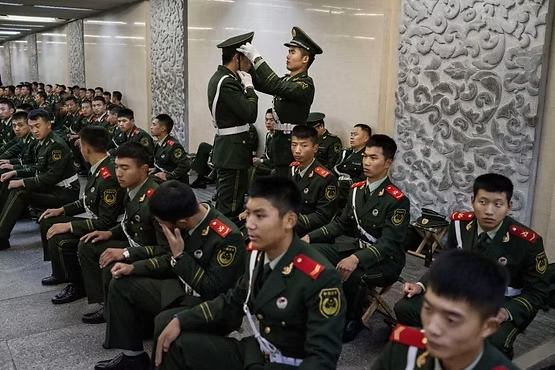
A paramilitary police officer adjusts another’s cap as they and others wait in an underground tunnel before securing the official flag raising ceremony at Tiananmen Square to mark the 66th National Day in Beijing, early on Oct. 1, 2015.Kevin Frayer—Getty Images

Police officers hold back crowds as they gather at the official flag raising ceremony at Tiananmen Square to mark the 66th National Day in Beijing, on Oct. 1, 2015.Kevin Frayer—Getty Images

People take pictures as they gather during the official flag raising ceremony at Tiananmen Square to mark the 66th National Day in Beijing, on Oct. 1, 2015.Kevin Frayer—Getty Images

Paramilitary police officers march following the official flag raising ceremony at Tiananmen Square to mark the 66th National Day in Beijing, on Oct. 1, 2015.Kevin Frayer—Getty Images

A girl poses in front of a large decorative flower arrangement after the official flag raising ceremony at Tiananmen Square to mark the 66th National Day in Beijing, on Oct. 1, 2015.Kevin Frayer—Getty Images

A paramilitary police officer guards in an underground tunnel after securing the official flag raising ceremony at Tiananmen Square to mark the 66th National Day in Beijing, on Oct. 1, 2015.Kevin Frayer—Getty Images

hich both parents were themselves only children.
For a while, the unprecedented policy could be considered a success, at least in terms of population goals. As TIME’s Hannah Beech reported in 2013:
The family-planning program, coupled with market reforms launched around the same time, is credited with catalyzing China’s modern transformation. With fewer bellies to feed, the government turned a hand-to-mouth society into the world’s second largest economy. Although many families, especially those in the countryside, are exempted from the one-child maximum, Chinese women bear, on average, about 1.5 children, compared with about 6 in the late 1960s.
But still, the law has been controversial since its inception, as it contributed to concerns over forced abortions and sterilization, and a gender imbalance resulting from female infanticide.
Now as China faces an aging and shrinking population rather than an exploding one, the government has decided to end the controversial policy.